
Criminal Court Records in Johnston County
A Johnston County criminal court record is the case file that opens when the State of Oklahoma charges someone with a crime. The Court Clerk records, files, and keeps these proceedings as permanent District Court records. Marci Sneed serves as the Johnston County Court Clerk, and her office in the courthouse at Tishomingo is the official keeper of every local felony and misdemeanor file. Each file holds the charging document, every court event, and the final outcome of the case. Online portals show much of this record, yet the clerk's file is the one the court treats as the official version.
Felony and misdemeanor cases are both heard in the Johnston County District Court, the general trial court for the county. Oklahoma runs District Courts in all 77 counties, and Johnston County sits in Judicial District 20. Felony cases carry CF case numbers; misdemeanors carry CM numbers. City ordinance offenses and some traffic citations can be filed in a municipal court instead, so those records may not show up in the District Court file. For a wider view of every case type the clerk keeps, the county's court records cover civil, family, probate, and traffic files alongside criminal matters.
How to Search Johnston County Criminal Court Records
Johnston County criminal court records are searched online through two free state systems. The county's Court Clerk page links out to On Demand Court Records, known as ODCR, and the Oklahoma State Courts Network, known as OSCN, carries Johnston County District Court in its case lookup. A criminal court records search starts with a defendant name or a case number.
- Open ODCR, choose Oklahoma District Courts, then select Johnston from the court list.
- Search by defendant name, a partial name, a case number, or a filed date range. ODCR allows free, unlimited name and case-number searches.
- If you already hold the case number, use OSCN case lookup and pick Johnston County District Court. Enter the case type, year, and sequence, such as CF-2024-1.
- Open the case to read the docket, the charges, and the disposition. Each docket entry is dated and lists filings, hearings, and orders.
- Request a certified copy from the Court Clerk when you need a file for court, a job, or any official use. Online copies are not certified.
For fines, costs, or a payment plan tied to a case, OSCN e-payments accepts a case number, a citation number, or a payment plan number for Johnston County. A statewide criminal history is a separate search, run by OSBI rather than read off a single court docket.
Note: Online court data is a convenience copy, so the Court Clerk record controls if a docket and the official file ever disagree.
What a Johnston County Criminal Court Record Shows
A criminal case file is built from many parts, and each field answers a different question about the case. The fields below appear across most Johnston County District Court criminal files, though older or sealed cases may show less. Reading them in order gives a clear picture of who was charged, with what, and how the case ended.
| Field | What It Shows |
|---|---|
| Case Number | The case type, year, and sequence, such as CF-2024-1 for a felony or CM-2024-1 for a misdemeanor. |
| Defendant | The person charged, named as the party the State of Oklahoma brought the case against. |
| Charges | The offense or offenses filed, the statute cited, the counts, and any later amended, reduced, or dropped charges. |
| Filing Date | The date the District Attorney filed the case in District Court. |
| Docket Entries | A dated log of filings, motions, hearings, continuances, warrants, and orders through the life of the case. |
| Plea | The defendant's formal answer, such as guilty, not guilty, or no contest. |
| Disposition | The final outcome of each charge: conviction, dismissal, acquittal, or deferral. |
| Sentence | The punishment imposed, which may include jail, prison, probation, fines, court costs, or restitution. |
Some details are kept back from public copies. Social Security numbers, financial account numbers, protected addresses, victim information, and any sealed attachment may be redacted, and juvenile material is generally removed.
Stages of a Criminal Case in Johnston County
A criminal case moves through set stages, and each one leaves a mark in the court record. The docket lists every step with a date, so the file reads like a timeline that runs from the first charge to the last order.
Case flow: Charges Filed › Arraignment › Pretrial / Motions › Plea or Trial › Disposition › Sentencing
It begins when the District Attorney files an Information or complaint that names the charge, the statute, and the counts. At arraignment the defendant first appears, hears the charges, and enters a plea. Pretrial work follows: lawyers file motions, trade evidence, and argue legal points while the court sets dates. The case then ends in a negotiated plea or goes to trial before a judge or a jury. The disposition records the result of each charge, and after a conviction or plea the judge imposes a sentence. Every one of these steps is logged in the file, so the docket alone can tell you how far a case has gone.
Charges vs. Convictions
Being charged is not the same as being convicted. A Johnston County criminal court record can show charges that were dropped, dismissed, or that ended in an acquittal. A charge is an accusation; a conviction is a finding of guilt by plea or verdict. Reading the disposition for each count is the only way to tell the two apart.
| Charge | Conviction | |
|---|---|---|
| Stage | Accusation filed by the State | Verdict or plea finding guilt |
| Burden of Proof | Probable cause | Beyond a reasonable doubt |
| Can Be Dropped | Yes, by dismissal or amendment | Stands unless reversed on appeal |
| Public Record | Yes | Yes |
The charging document itself, and how a charge can change over the life of a case, is covered in more detail on the county's court charge records page.
Reading Dispositions and Sentences in Johnston County
The disposition is the final answer the record gives for each charge. A case can have one disposition or several, since each count is decided on its own. The terms below show up often in Johnston County criminal files and are worth knowing before you read a result.
- Guilty plea
- The defendant admits the charge, and the court enters a conviction.
- Not guilty
- A plea entered to contest the charge; the case then heads toward trial.
- Dismissed
- The charge is dropped. A dismissal with prejudice cannot be refiled; without prejudice, it may be refiled if allowed.
- Nolo contendere
- A no-contest plea, treated like a conviction for sentencing but not an admission of fault.
- Deferred sentence
- A judgment is held back while the defendant meets conditions; the case may be dismissed if those terms are met.
- Acquittal
- A finding of not guilty after trial.
The sentence reads alongside the disposition. It can list a term of confinement, a probation period, fines, court costs, and restitution to a victim. Payment entries and any later revocation also appear in the docket.
Who Files Criminal Charges in Johnston County
Charges are filed by the District Attorney, not by the police and not by the court. Johnston County falls under Oklahoma District 20, led by District Attorney Melissa Handke. The District 20 office covers Carter, Johnston, Love, Marshall, and Murray counties, and the Johnston County office sits in the courthouse at 403 W. Main in Tishomingo. The DA reviews the case, decides what to file, and prosecutes it through the District Court. That office is the source of the filed charge that opens the criminal case record.
Defendants who cannot afford a lawyer may qualify for appointed counsel. The Oklahoma Indigent Defense System handles non-capital trial defense for Johnston County, and its Johnston County page lists Melanie Blackburn as the local contractor, based at 333 W Main St, Suite 475, Ardmore, OK 73401, reachable at 580-223-2599. The same office covers Carter, Love, Marshall, and Murray counties. Appointed defense entries, such as counsel appointments, also appear in the court record.
Note: The District Attorney can amend, add, reduce, or drop charges as a case develops, and each change is logged as a dated entry in the file.
Oklahoma Criminal History Through OSBI CHIRP
A single case file is not the same as a full criminal history. For a statewide record that pulls together a person's Oklahoma arrests and dispositions, the source is the Oklahoma State Bureau of Investigation. OSBI runs a paid online service called CHIRP that returns a name-based criminal history search. It is separate from the Johnston County case file and from the jail roster, and it carries set fees. The OSBI CHIRP portal shows the service and its current charges.
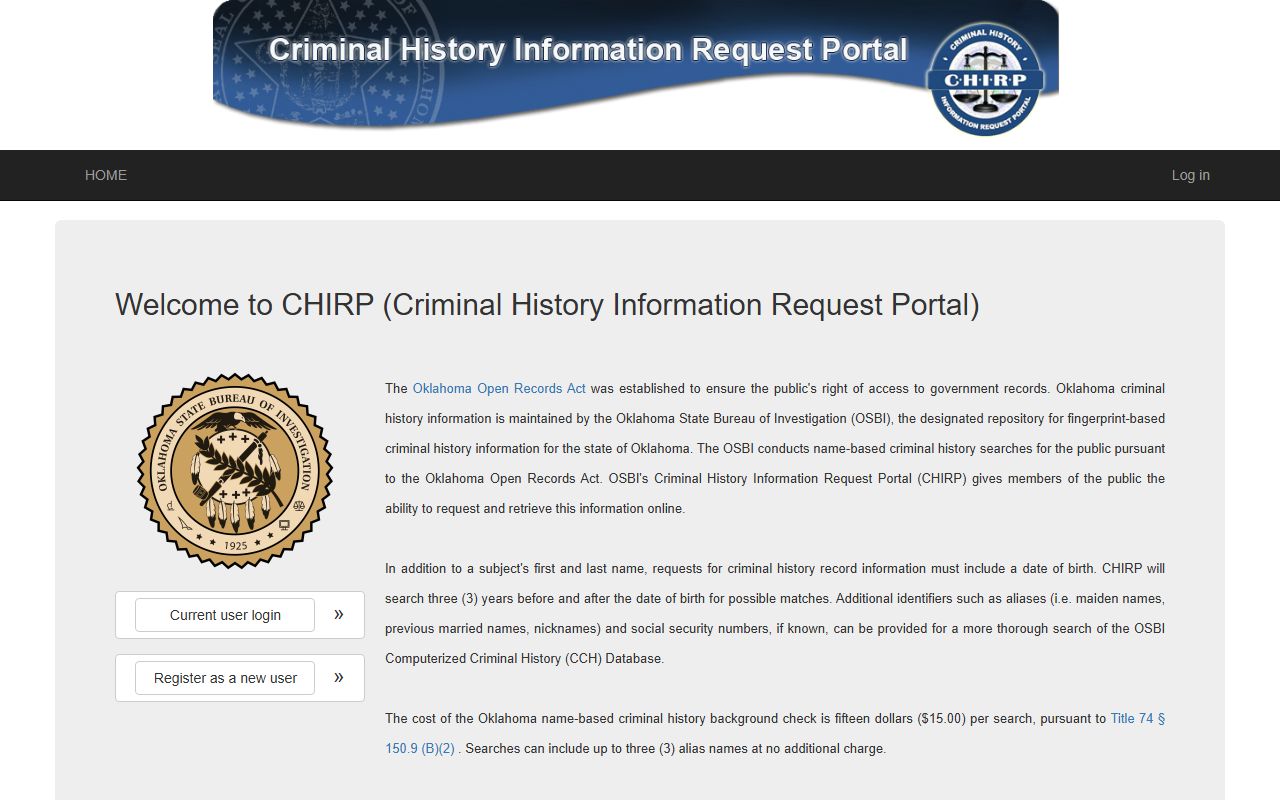
The portal is where a member of the public can buy a criminal history check rather than read one free court docket at a time. The fees below apply to CHIRP searches at the time of writing.
| OSBI CHIRP Service | Fee |
|---|---|
| OSBI criminal history database search | $15 |
| DOC sex offender registry search | $2 |
| DOC violent offender registry search | $2 |
| Online convenience transaction fee | $1 |
Use CHIRP when you need a person's broad Oklahoma history. Use ODCR or OSCN when you want the actual Johnston County case file, with its docket, motions, and sentence.
Sealed vs. Expunged Records
Not every criminal record stays open forever. Oklahoma law lets certain cases be sealed or expunged, and the two are not the same. A sealed record is closed to public view but still exists. An expunged record is treated as though the case never happened for most purposes. Both require legal steps, and neither is done by simply removing a case from a website.
| Sealed | Expunged | |
|---|---|---|
| Visibility | Hidden from public access | Treated as never existed for most uses |
| Law Enforcement | Limited access remains | Very limited access |
| How It Happens | By statute or court order | By court order under Title 22 |
| Eligibility | Set by Oklahoma statute and the court | Categories listed in Title 22, Section 18 |
The OSBI expungement information page explains that the bureau cannot pre-approve who qualifies; eligibility runs through the court under Title 22, Section 18.
That page makes the practical point that a record is not cleared by deleting a search result. The expungement path runs through the court, step by step.
- Confirm you fit one of the eligibility categories in Title 22, Section 18.
- File a petition or motion in the District Court that handled the case.
- Give notice to the agencies the law requires, such as OSBI and the District Attorney.
- Attend the hearing and obtain a judge's order.
- After the order, the agencies seal or remove public access according to its terms.
A dismissed case is not automatically an expunged case. A dismissal may still be public unless it is later sealed or expunged by order.
Public Access to Johnston County Criminal Records
Oklahoma treats most court records as open. The Oklahoma Open Records Act sets the default that public bodies must allow access unless a statute requires confidentiality. Criminal case files in the District Court fall under that rule, which is why ODCR and OSCN can publish dockets to anyone. Copy and certification fees may still apply when you ask the clerk for a paper file.
Key Statutes:
Oklahoma Open Records Act, Title 51 § 24A.1 et seq. - Public bodies must give access to records unless a law allows or requires they be kept private.
Title 51 § 24A.5 - Offices may charge copy fees within statutory limits and must post a fee schedule.
OCCA Rule 2.6 - OSCN online case search is public convenience access, but the official case-management record controls if the two differ.
Restricted Criminal Court Records in Johnston County
Some criminal records are closed to the public even though most are open. The court withholds these by law or by order, and the Court Clerk will limit what it releases without proper authority. Knowing which records are restricted saves a wasted trip to the counter.
- Juvenile cases, which are largely confidential under Title 10A and usually need party status, attorney authority, or a court order.
- Sealed and expunged cases, which are closed once a judge signs the order.
- Mental health commitment proceedings, which are sensitive and generally restricted.
- Adoption matters, which are not handled as ordinary public files.
- Redacted details inside an open file, such as Social Security numbers, protected addresses, and victim information.
When a record is missing online, it may be sealed, juvenile, or simply older than the indexed range. The Court Clerk can tell you whether a file exists and what it takes to view it.
Background Check Considerations
A casual court search is not the same as a formal background check. Reading a free docket on ODCR or OSCN tells you about one case. A regulated background check, used for hiring or housing, must follow the Fair Credit Reporting Act and is run by an authorized agency. For a person's full Oklahoma history, the OSBI CHIRP search is the official paid source rather than a single county docket.
Important: This site is a privately operated resource, not an FCRA-regulated consumer reporting agency, and its information may not be used for credit, employment, tenant, or insurance decisions.