
Johnston County Arrest Records and Court Charges
A Johnston County arrest record is the record of an arrest itself. It names the person taken into custody, the agency that made the arrest, and the booking that follows. Most arrests here come from the county sheriff or a state agency such as the Oklahoma Highway Patrol. An arrest does not decide guilt. It only starts the process. After an arrest, a prosecutor reviews the case and decides what to file. The District Attorney for District 20 files the formal charges with the Court Clerk, and those charges become the court charge record. One event splits into two records: the arrest on the law enforcement side, and the charges on the court side.
These two records live in different places. The arrest and booking side sits with the sheriff and the jail, where the roster shows who is in custody right now. For booking detail and the current roster, see the Johnston County inmate records. The court charge record is what the prosecutor filed and how each count moves through the case. Court charges after arrest show up in the District Court file kept by the Court Clerk. The full case file, with pleas, hearings, and the final outcome, lives in the criminal court records.
How to Find Johnston County Arrest Records
Charges and charge status are public through the state court search tools that Johnston County links from its official site. The Court Clerk points searchers to On Demand Court Records, and the Oklahoma State Courts Network carries Johnston County District Court in its case lookup. Booking and custody detail is not in these court tools. That data sits in the jail roster on the sheriff side. Court records show the charges, not the mugshot.
- Open On Demand Court Records, the public portal the county links for District Court cases.
- Search by the defendant name, a partial name, or the case number, then pick Johnston from the court list.
- Open the case and read the list of charges filed against the defendant.
- Check each charge for its statute code, its level, and its current status.
Charges that roll up into a statewide criminal history are searched a different way. The Oklahoma State Bureau of Investigation runs a paid criminal-history service through its CHIRP portal. For a case with an unpaid balance, the OSCN e-payments search finds it by case number, citation number, or payment plan number.
Online tools do not hold everything. Older cases, sealed files, and records still being entered may not appear. When a charge does not show up online, the Johnston County Court Clerk in Suite 201 at 403 W. Main in Tishomingo keeps the official District Court file. The counter staff can confirm a case, pull a charge list, and provide certified copies. The clerk phone is 580-371-3281. Certified copies are the version courts and agencies accept, since the online docket is convenience access only.
Note: Court of Criminal Appeals Rule 2.6 says the online case search is for convenience, and the official case-management record controls if the two ever differ.
How Johnston County Charges Get Filed
An arrest does not create a charge by itself. The charge record begins when a prosecutor files a charging document with the court. In Oklahoma, that document takes one of three forms. The form depends on the level of the offense and how the case reaches the court. Each one starts the formal case and lists the counts the state intends to prove.
| Complaint | Information | Indictment | |
|---|---|---|---|
| Filed By | Officer / Prosecutor | Prosecutor | Grand Jury |
| Common For | Misdemeanors | Many felonies | Serious felonies |
| Starts | The case | The case | The case |
In Johnston County, the District Attorney for District 20 files most of these charges. That office decides which counts to bring, drop, or amend as the case develops. The charging document is the first place a reader sees the exact offense, the statute, and the count number tied to an arrest.
Charge Status in Johnston County Records
Charges are not fixed once filed. They change as the case moves through District Court. A prosecutor can amend a charge, reduce it, add a count, or drop it. A judge can dismiss a count. The docket records each change, so the status you see is the current state of that count, not always the charge first filed.
| Status | What It Means |
|---|---|
| Pending | The charge is filed and active; no final outcome has been reached on that count. |
| Amended / Reduced | The prosecutor changed the charge, often to a lower level or a different statute. |
| Dismissed | The court dropped the charge; a dismissal can be with or without the right to refile. |
| Nolle Prosequi | Latin for "will not prosecute"; the state chose not to pursue the count. |
Note: A dismissed charge can still appear in the public Johnston County court file unless it is later sealed or expunged under Oklahoma law.
Johnston County Charges vs. Convictions
Being charged is not the same as being convicted. A charge is an accusation, and the state must still prove it. A conviction comes only after a guilty plea, a no contest plea, or a verdict of guilt. Many charges end without a conviction through dismissal, reduction, or acquittal. Both the charge and any conviction can appear in the public court file, so reading a charge record means checking how each count finally resolved.
| Charge | Conviction | |
|---|---|---|
| Stage | Accusation | Verdict or plea |
| Burden of Proof | Probable cause | Beyond reasonable doubt |
| Public Record | Yes | Yes |
This gap matters for anyone reading a record. A charge that was later dropped is not proof of wrongdoing. A reduced charge may not match the offense first booked at arrest. The safest reading checks the final disposition on every count before drawing any conclusion. A Johnston County arrest record and the charges that follow can both sit in the file long after a case ends, so the outcome line is the one that tells you what actually happened.
Sealed vs. Expunged Charge Records
Some charge records can be closed to the public. Oklahoma lets records be sealed or expunged when a person qualifies. The two are not identical, and neither happens just because a case ended. A person must meet the eligibility categories set in state law and obtain a court order.
| Sealed | Expunged | |
|---|---|---|
| Visibility | Hidden from public | Destroyed / treated as never existed |
| Law Enforcement | Limited access | Very limited |
| Eligibility | Court order under Title 22, Section 18 | Court order; OSBI cannot pre-approve |
A Johnston County record is not cleared by deleting it from a website. Eligibility lives in Title 22, Section 18, and the OSBI expungement guidance explains that the bureau cannot decide eligibility before a judge signs an order. A dismissed case is not sealed on its own. It can stay public until a court grants relief.
Charge Codes and Severity Levels
Each charge ties to a specific Oklahoma statute. The charging document lists the code, the offense text, and the count number. The code sets the level of the offense. Oklahoma sorts crimes into felonies and misdemeanors, with traffic and minor matters often handled as lesser violations. A felony is the most serious level. A misdemeanor carries lighter penalties. One arrest can produce several separate charges, each with its own code and level, so a single case file may list several counts.
Counts matter because each one can resolve on its own. A case can end with one count dismissed, one reduced, and one ending in a plea. Reading only the top charge can give a false picture of how the case turned out.
Statewide Criminal History Lookups
Local charge records and statewide criminal history are two different things. The District Court file shows the charges in one county case. A statewide criminal history pulls together arrests, charges, and dispositions from across Oklahoma. The Oklahoma State Bureau of Investigation runs that search through its CHIRP portal. The OSBI criminal history search costs $15, the sex offender registry search and the violent offender registry search cost $2 each, and an online transaction adds a $1 convenience fee.
Statewide charge data also feeds public-safety registries described by the Oklahoma Attorney General's sex offender registry resource.
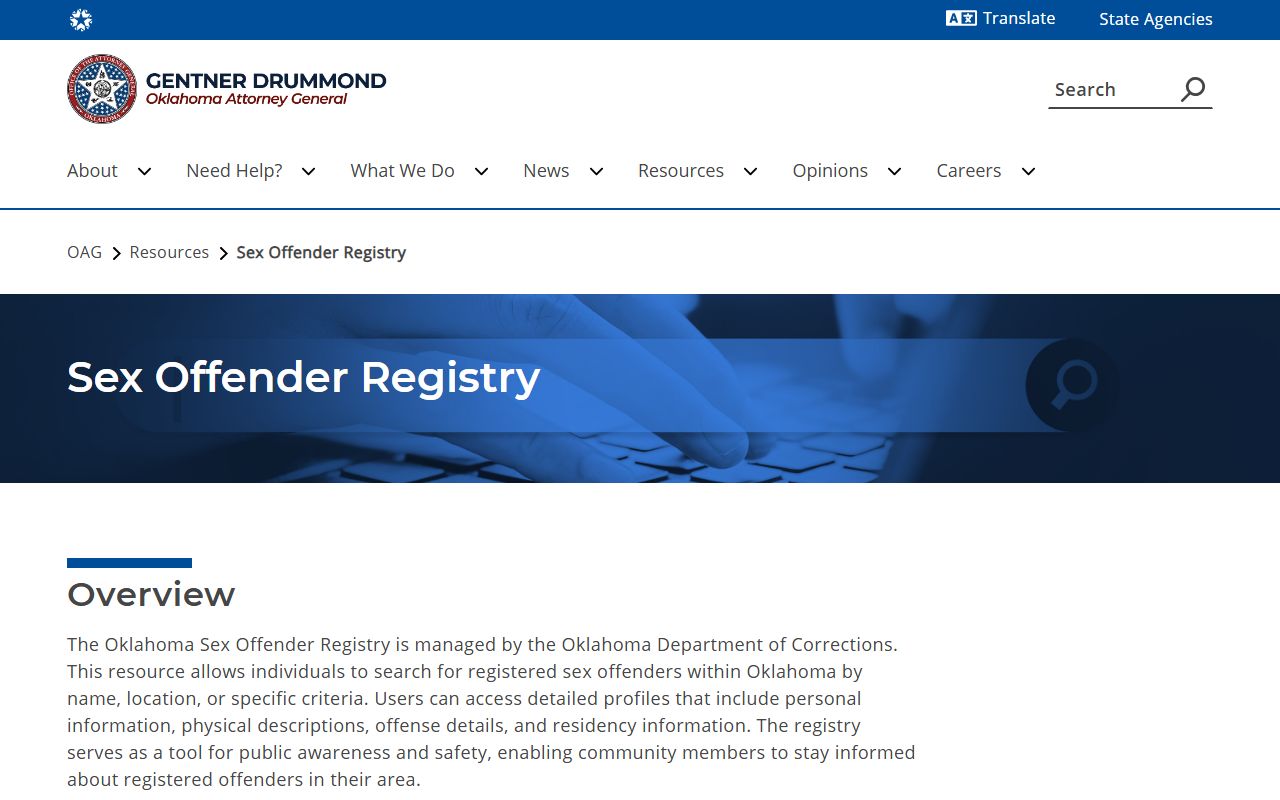
Those registries are separate from the Johnston County court charge file, but both draw on the same underlying arrest and charge records. When a person moves from county custody into a state sentence, their status shifts to the Oklahoma Department of Corrections offender lookup. The county court file still holds the charges, while custody and supervision detail moves to the state level.
Background Check Considerations
People search charge records for many reasons. Some are casual checks. Others are formal background checks for jobs, housing, or licensing. Those formal checks fall under the federal Fair Credit Reporting Act and must run through a regulated consumer reporting agency. A casual look at a public court docket is not the same as an FCRA-compliant report. Oklahoma law also requires law enforcement to make certain arrest and incident information available when it is kept, under Title 51, Section 24A.8. The broader Oklahoma Open Records Act supports public access to many records, yet it does not turn a docket search into a screening report.
Important: Johnston County Court Records is not a consumer reporting agency under the FCRA, and nothing here may be used for credit, employment, tenant, or insurance decisions.
Restricted Charge Records in Johnston County
Not every charge record is open. Oklahoma keeps several categories restricted. Juvenile charges are largely confidential under Title 10A, and access usually needs party status, counsel, or a court order. Sealed and expunged charges drop out of public view once a judge signs the order. Charges tied to an ongoing investigation may be withheld. Dismissed counts can stay public unless they are sealed. For records that do not appear online, the Johnston County Court Clerk counter is the place to confirm what is releasable and to request certified copies.
Defendants who cannot afford counsel may qualify for appointed representation. The Oklahoma Indigent Defense System covers Johnston County for non-capital trial defense, and that office is the routing point for public-defense questions tied to filed charges.